
When an HVAC or refrigeration system is low on refrigerant, the missing refrigerant is not the diagnosis. It is evidence that the system needs further investigation. A frozen evaporator coil, reduced capacity, abnormal operating pressures, or a history of repeated refrigerant additions may help establish the symptoms. None of those observations identifies the leak by itself.
The footage in the video above comes from several service calls. It is not one customer story. Together, the clips show the larger process: recognize the symptom, inspect likely failure points, search the circuit, narrow the area, repair the source, and verify the system before returning it to service.
Experience determines where the search begins
Refrigerant systems contain many possible leak points. Service valves, Schrader cores, brazed joints, coil return bends, distributor tubing, filter driers, and tubing exposed to vibration all deserve attention. The best starting point depends on the equipment, its service history, and the symptom reported by the customer.
A visual inspection can provide useful direction. Oil residue may appear where refrigerant and compressor oil have escaped together. Corrosion, damaged tubing, and copper-to-copper rub points may identify areas that need closer testing. Visual evidence is valuable, but many leaks are too small or too well hidden to be found by sight alone.
Electronic detection narrows the search
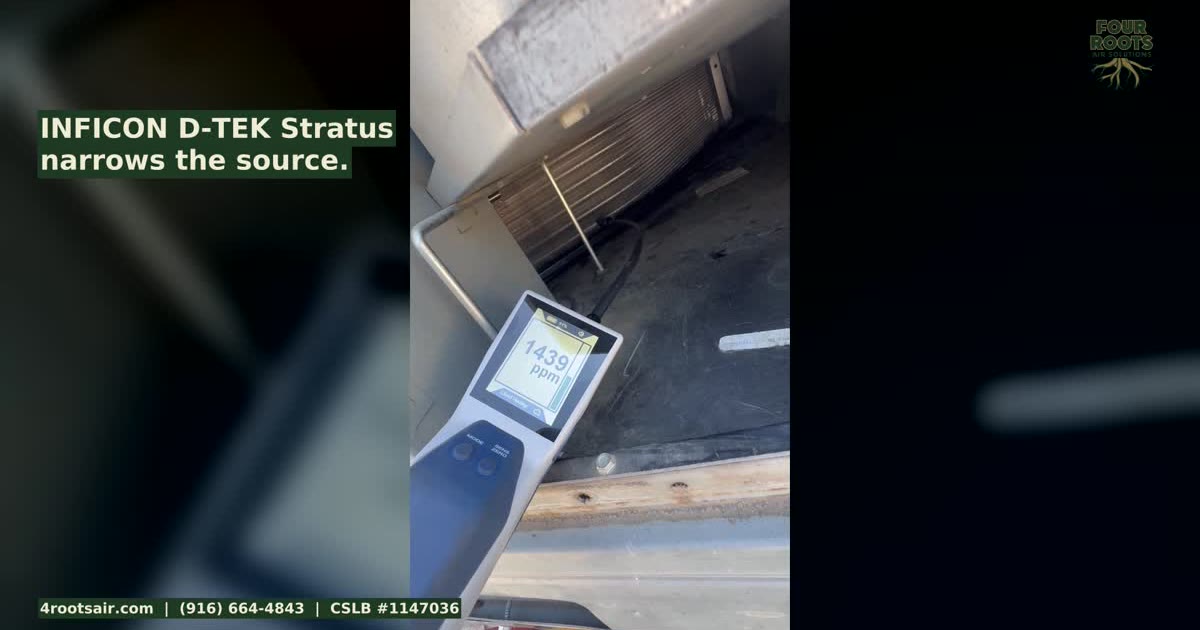
Four Roots Air Solutions uses an INFICON D-TEK Stratus as one of its electronic leak-detection tools. The flexible probe allows the technician to sample the air close to coils, joints, valves, and other suspected areas. A response can narrow the search, but technique matters. Probe speed, distance from the component, airflow, and background refrigerant can all affect what the detector displays.
A useful response should be repeatable. The technician may approach the area again, change the probe position, control nearby airflow, or compare the response with adjacent components. The goal is not to chase the highest number on a screen. The goal is to move from a broad system complaint to a defensible leak location.
Different conditions require different methods
No single leak-detection method is ideal for every job. Electronic detection is useful for searching a large circuit and narrowing the area. Bubble solution can provide visible confirmation at an accessible joint or fitting. Dry-nitrogen pressure testing can help verify that a sealed circuit is losing pressure. On larger or more complex equipment, isolating sections of the circuit can reduce the number of possible leak locations.
These methods work together. Field experience helps determine which method to use first and when the result needs to be confirmed another way. That combination can reduce unnecessary disassembly and shorten the time the equipment remains unavailable.
Brazing the repair is not the final step
The repair footage shows a copper refrigerant connection being brazed. That is an important physical step, but it does not prove that the repair is complete.
After the connection or failed component is repaired, the refrigerant circuit still has to be pressure tested. A proper test checks whether the repair holds and whether another leak remains elsewhere in the circuit. The system must then be evacuated to remove air and moisture before refrigerant is returned. Finally, the charge and system operation should be verified under operating conditions.
This sequence matters because sealing one visible leak does not guarantee that it was the only leak. It also does not guarantee that the system is clean, dry, correctly charged, or operating as designed. A completed repair includes verification, not just workmanship at the joint.
For a real-world example of this process under time pressure, read how we tracked down a rub-through leak on a 5-ton rooftop unit serving a commercial kitchen.
Better diagnosis supports better decisions
An efficient leak search saves more than service time. It reduces unnecessary part replacement, limits avoidable downtime, and gives the customer a clear basis for deciding whether to repair the equipment or plan for replacement.
Four Roots Air Solutions provides residential HVAC, commercial HVAC service, and commercial refrigeration service throughout the Sacramento Valley and Placer County corridor. If your system has a recurring refrigerant problem or you need an independent second opinion, call or text (916) 664-4843.
Four Roots Air Solutions
CSLB #1147036
Leave a Reply