
By David Quezada, owner of Four Roots Air Solutions, Loomis, CA | CSLB #1147036
Short answer: CO2 heat pump water heaters, like the SANCO2 from Sanden and the new A. O. Smith Voltex X, heat water with carbon dioxide (R-744) as the refrigerant. CO2 runs at much higher pressures than the refrigerants in a typical air conditioner or standard heat pump water heater, and it behaves differently inside the system. Diagnosing these units well takes someone who understands CO2 refrigeration and the plumbing side of a water heater. Four Roots Air Solutions brings both, including direct experience with CO2 refrigeration systems that carries over to these water heaters.
Key takeaways
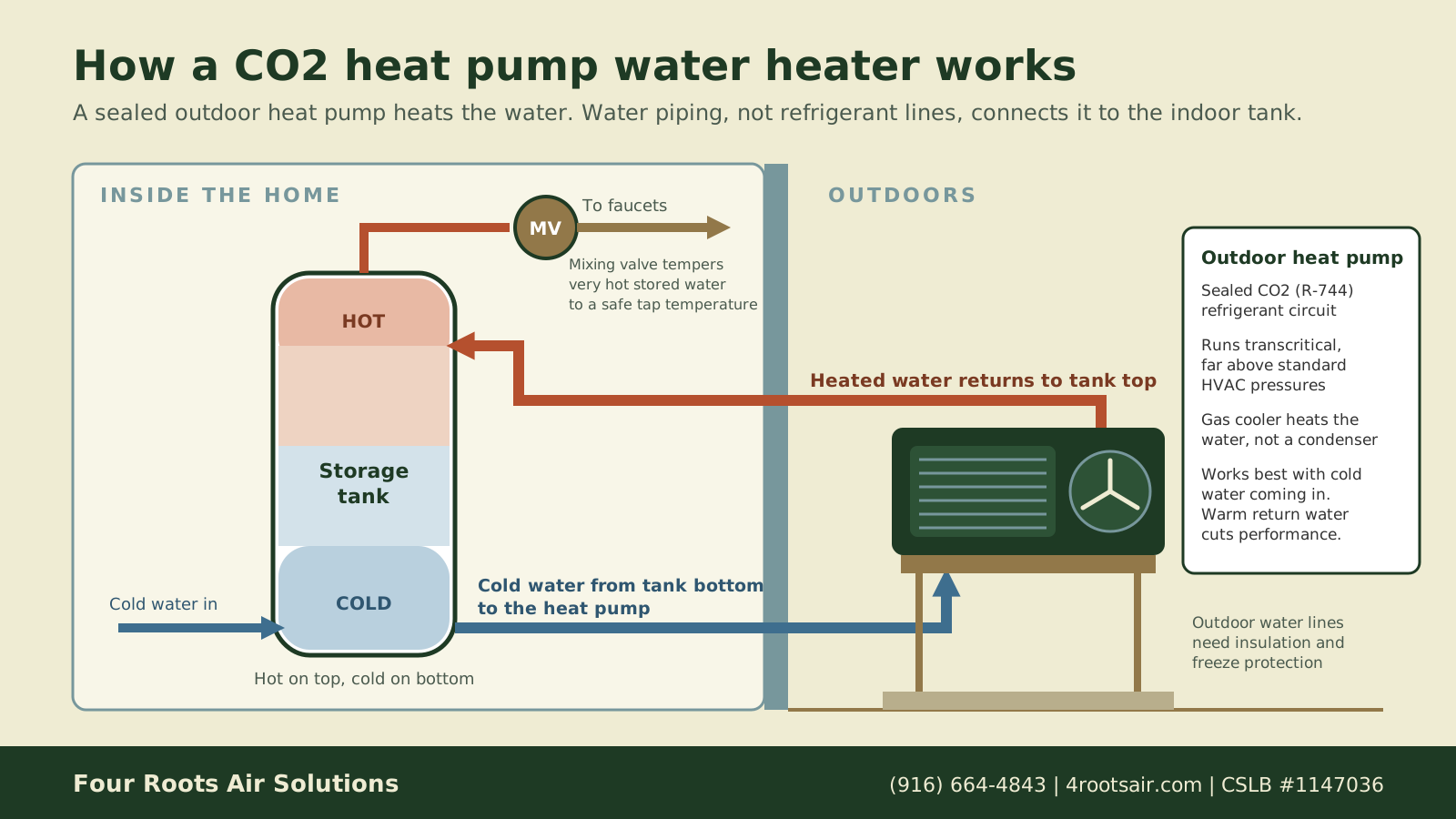
- CO2 heat pump water heaters are split systems: a sealed outdoor heat pump connected by water piping to an indoor storage tank.
- CO2 operates at pressures far above common HVAC refrigerants and does not condense the way R-410A or R-454B does. That changes how the system is diagnosed.
- Many “not enough hot water” complaints on CO2 units come from the water side: piping, recirculation, mixing valves, strainers, or freeze damage, not a failed heat pump.
- The tools, gauges, and procedures for CO2 are different. A technician who has only worked on conventional refrigerants is starting from scratch.
- We work on CO2 water heaters from manufacturers including Sanden (SANCO2) and A. O. Smith.
What is a CO2 heat pump water heater?
A heat pump water heater works like an air conditioner in reverse. Instead of pulling heat out of your house, it pulls heat out of the air and moves it into your water. Most heat pump water heaters sold in the U.S. are all-in-one units that sit in a garage or utility room and use refrigerants such as R-134a.
CO2 models are built differently:
- The heat pump sits outside. It contains the compressor, fan, refrigerant circuit, and the heat exchanger where the water gets heated.
- The tank sits inside. It stores the hot water, the same way a conventional tank does.
- Water piping connects the two. Cold water travels from the bottom of the tank to the outdoor unit, gets heated, and returns hot to the top of the tank. There is no refrigerant line set between them; the CO2 circuit stays sealed inside the outdoor unit.
Because the heat pump is outdoors, it does not cool down the room the tank is in, and it does not make noise inside the house. CO2 can also heat water to high temperatures and keep working in cold weather, so these systems are typically paired with a mixing valve that lets the tank store very hot water and temper it to a safe temperature at the tap.
Sanden SANCO2
The SANCO2 has been the best-known CO2 water heater in North America for years. It is sold here through ECO2 Systems, with tank options in several sizes, and it is common in all-electric homes, high-performance new construction, and solar homes.
A. O. Smith Voltex X
A. O. Smith introduced the Voltex X in 2026, pairing a Panasonic CO2 outdoor heat pump with an A. O. Smith tank. It is a newer option built to fit tighter spaces, so many homeowners and even many contractors have not seen one in the field yet.
Why CO2 is different from the refrigerants most technicians know
Most HVAC technicians spend their careers on R-22, R-410A, and now R-454B and R-32. CO2 works on the same basic principle, but the details change almost everything about how you diagnose it.
1. Much higher operating pressures
A CO2 system runs at pressures several times higher than an R-410A system. The standard manifold gauges and many service tools on a typical HVAC truck are not rated for those pressures. Hooking up the wrong equipment is not just inaccurate. It is unsafe.
2. It does not condense the way other refrigerants do
In a normal air conditioner, refrigerant condenses from a gas to a liquid in the outdoor coil, and technicians read that process with pressure, saturation temperature, and subcooling. CO2 has a low critical temperature, about 88°F. In a water heater, it typically operates above that point on the high side, which is called transcritical operation. The heat exchanger is a gas cooler, not a condenser, and the usual “read the saturation temperature” approach does not apply.
3. Incoming water temperature drives performance
A CO2 water heater depends on cold water entering the outdoor unit. The colder the water coming back from the bottom of the tank, the more efficiently the gas cooler can pull heat out of the CO2. When warm water reaches the outdoor unit, performance drops, and the unit can short cycle or appear to be failing.
This is the single biggest reason a technician needs to understand both the refrigeration side and the plumbing side. A recirculation loop piped into the wrong port, a mixing valve set up incorrectly, or a tank that has lost its temperature layering can all send warm water to the heat pump. The heat pump gets blamed for a plumbing problem.
Refrigeration experience that carries over
Before founding Four Roots Air Solutions, David spent three years installing transcritical CO2 refrigeration racks, the large multi-compressor systems that run modern commercial refrigeration. Building those systems means piping, pressure testing, evacuating, charging, and starting up equipment that runs on CO2 at high pressure. A CO2 water heater uses the same transcritical cycle, so the principles carry straight over:
- Reading high-side pressure and gas cooler temperatures instead of condensing pressure and subcooling
- Understanding how gas cooler outlet temperature controls capacity and efficiency
- Working safely at CO2 pressures, with tools and gauges rated for them
- Recognizing how inverter compressors, electronic expansion valves, and system controls respond to changing conditions
A water heater is a much smaller system than a commercial refrigeration rack, but the refrigerant behaves the same way. That background lets us separate a true heat pump fault from a water-side or installation problem instead of guessing.
Common CO2 water heater problems we diagnose
Not enough hot water, or the tank recovers slowly
Often caused by warm water returning to the outdoor unit, a misconfigured recirculation loop, an incorrect mixing valve setup, or a tank that is undersized for the household. Sometimes it is a heat pump fault. The point of diagnosis is to know which.
Error codes or the outdoor unit will not run
Can point to sensor or thermistor faults, water flow problems, power supply issues, or a fault in the outdoor unit itself. Each manufacturer uses its own codes and troubleshooting sequence, and we follow them.
Restricted water flow
Clogged inlet strainers, scale buildup in hard water, air in the lines, or a failing circulator pump can all restrict flow through the heat exchanger and shut the system down.
Freeze damage to the water piping
The water lines running to the outdoor unit need insulation and freeze protection. In the foothills above Loomis, winter nights get cold enough for this to matter. If water lines freeze during a power outage or because insulation has failed, they can split.
Water leaks at the tank or connections
Relief valve discharge, leaking fittings, or tank issues are handled with the same care as any water heater, with attention to what the outdoor system needs to keep running.
What a CO2 water heater service visit looks like
- Listen to the complaint. When does the hot water run short? How old is the system? Was it installed with a recirculation loop?
- Check the water side. Piping configuration, recirculation, mixing valve, strainers, insulation, and inlet and outlet water temperatures.
- Check the outdoor unit. Error history, electrical supply, airflow across the coil, and system operation, using the manufacturer’s diagnostic procedures and tools rated for CO2.
- Explain what we found. You get a clear answer on what is wrong and what it takes to fix it, whether that is a plumbing correction, a part, or a manufacturer warranty claim.
Frequently asked questions
Are CO2 heat pump water heaters reliable?
They are proven technology that has been used for years in Japan and has been sold in North America for well over a decade. Like any system, they perform best when they are installed correctly and serviced by someone who understands how they work.
Can any plumber or HVAC technician service a CO2 water heater?
A plumber can handle the tank and water connections, and an HVAC technician knows heat pumps. A CO2 unit needs both. The refrigerant pressures, the gas cooler, and the importance of incoming water temperature are outside the everyday experience of most technicians in either trade.
Why is my SANCO2 or Voltex X running out of hot water?
The most common causes are warm water returning to the outdoor unit, a recirculation loop or mixing valve that is not set up correctly, restricted water flow, or a tank that is too small for how the household uses hot water. A heat pump fault is also possible. A proper diagnosis checks the water side and the outdoor unit together.
Do CO2 water heaters work in cold weather?
Yes. One advantage of CO2 is that it keeps heating water efficiently at outdoor temperatures well below anything the Sacramento Valley sees. The outdoor water piping still needs to be protected from freezing.
Will service affect my manufacturer’s warranty?
Warranty terms and registration requirements vary by manufacturer and model. We follow the manufacturer’s service procedures and can help you work through a warranty claim when a covered part fails.
Have a CO2 water heater that needs attention?
If your SANCO2, Voltex X, or other CO2 heat pump water heater is not keeping up, throwing error codes, or leaking, call a contractor who understands both the refrigeration and the plumbing. At Four Roots Air Solutions, we diagnose the whole system before recommending a fix.
Call (916) 664-4843 or request service from Four Roots Air Solutions to schedule a CO2 water heater service visit.
Based in Loomis, CA, and serving Sacramento, Placer County, and surrounding areas.
Four Roots Air Solutions | CSLB #1147036
Leave a Reply