
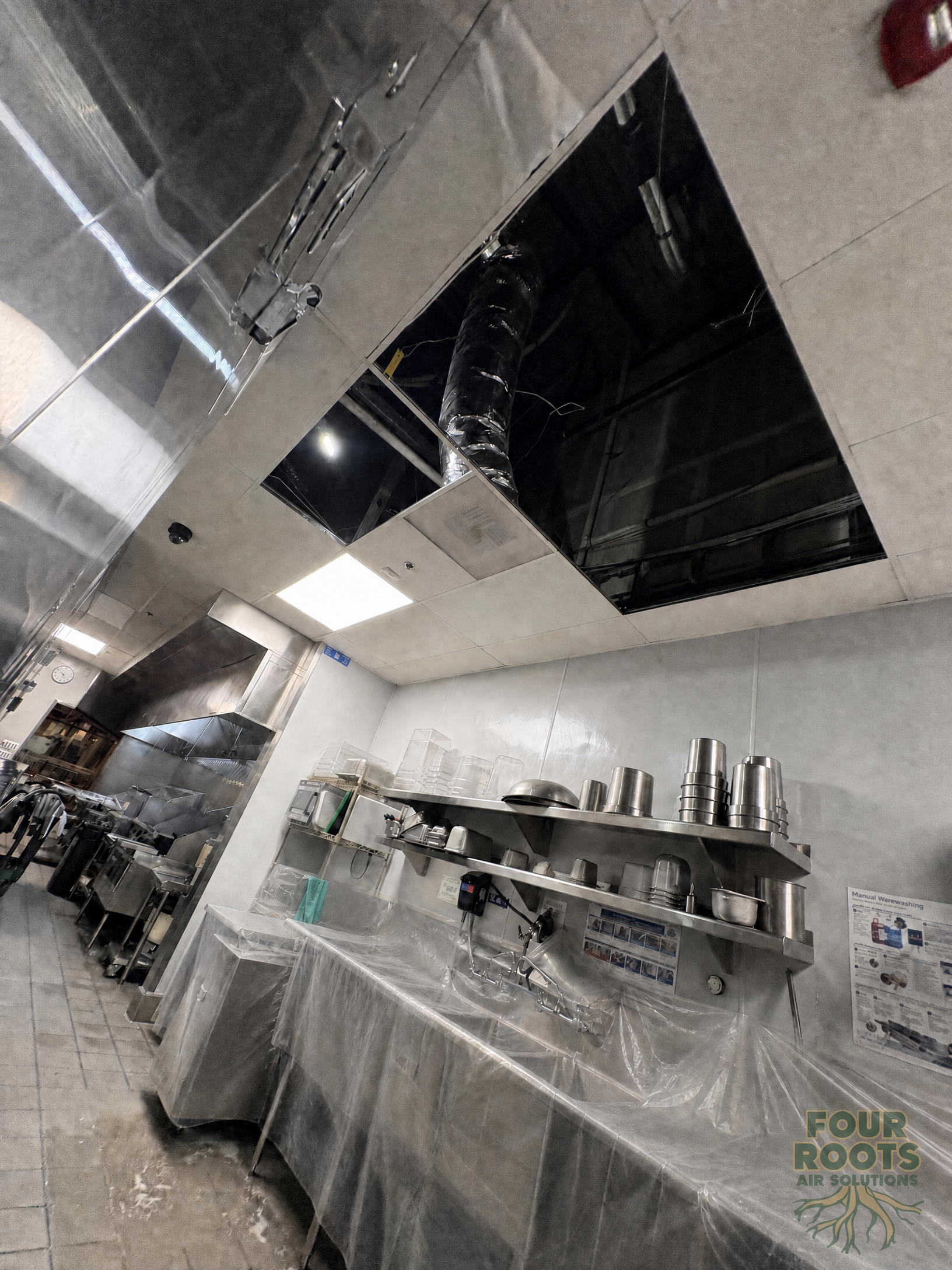
The restaurant called about water coming through the ceiling above their prep line. Stained tiles, sagging grid, drips landing on stainless.
From the floor that looks like a roof leak. It was not. The water was condensation, and it was coming off the refrigerant linesets serving the walk-in fridge and freezer, running above the t-bar grid. Rodents had chewed through the insulation.
Why chewed insulation turns into a water problem
Insulation on a refrigeration lineset is not doing the job most people assume.
On a heating system, insulation saves energy. Some heat escapes, you pay a little more, nothing else happens.
On a walk-in fridge or freezer lineset, insulation is a vapor barrier. That copper runs well below the dew point of the air around it, and a commercial kitchen ceiling cavity is full of warm, humid air. The insulation’s actual job is to keep that air from ever touching the cold pipe. Break the barrier anywhere and moisture condenses directly on the copper.
Rodents are very good at breaking it. Closed cell foam is soft, it sits in a dark protected cavity, and nothing about it discourages chewing.
Once the barrier opens up, the sequence runs on its own. Humid air reaches bare copper. Water condenses and runs down the pipe. It soaks into the surrounding insulation, and it drips onto whatever sits below, which in this case was the ceiling grid over an active kitchen.
Why we would not patch it with tape
The lower cost instinct here is to tape the chewed sections and move on. We looked at that and could not recommend it, for a reason worth understanding:
Once closed cell insulation gets wet, it loses effectively all of its R-value until it is fully dried out. Taping over a saturated section does not restore anything. The wet foam stays wet, the pipe underneath stays cold, and the vapor barrier is still discontinuous. Warm humid air keeps finding the copper and the dripping keeps going.
There is a practical argument too. The aerial lift, the after hours access, and the labor to physically reach piping running 35 feet per lineset with rooftop equipment about 25 feet above the grid are all required no matter which approach you pick. Once you are up there with a lift at midnight, the added cost of stripping and replacing the insulation outright is small next to the cost of getting there. Spot repairs cost nearly the same and leave you with the same problem.
What the repair actually involved
The technical work was straightforward. Getting to it was not.
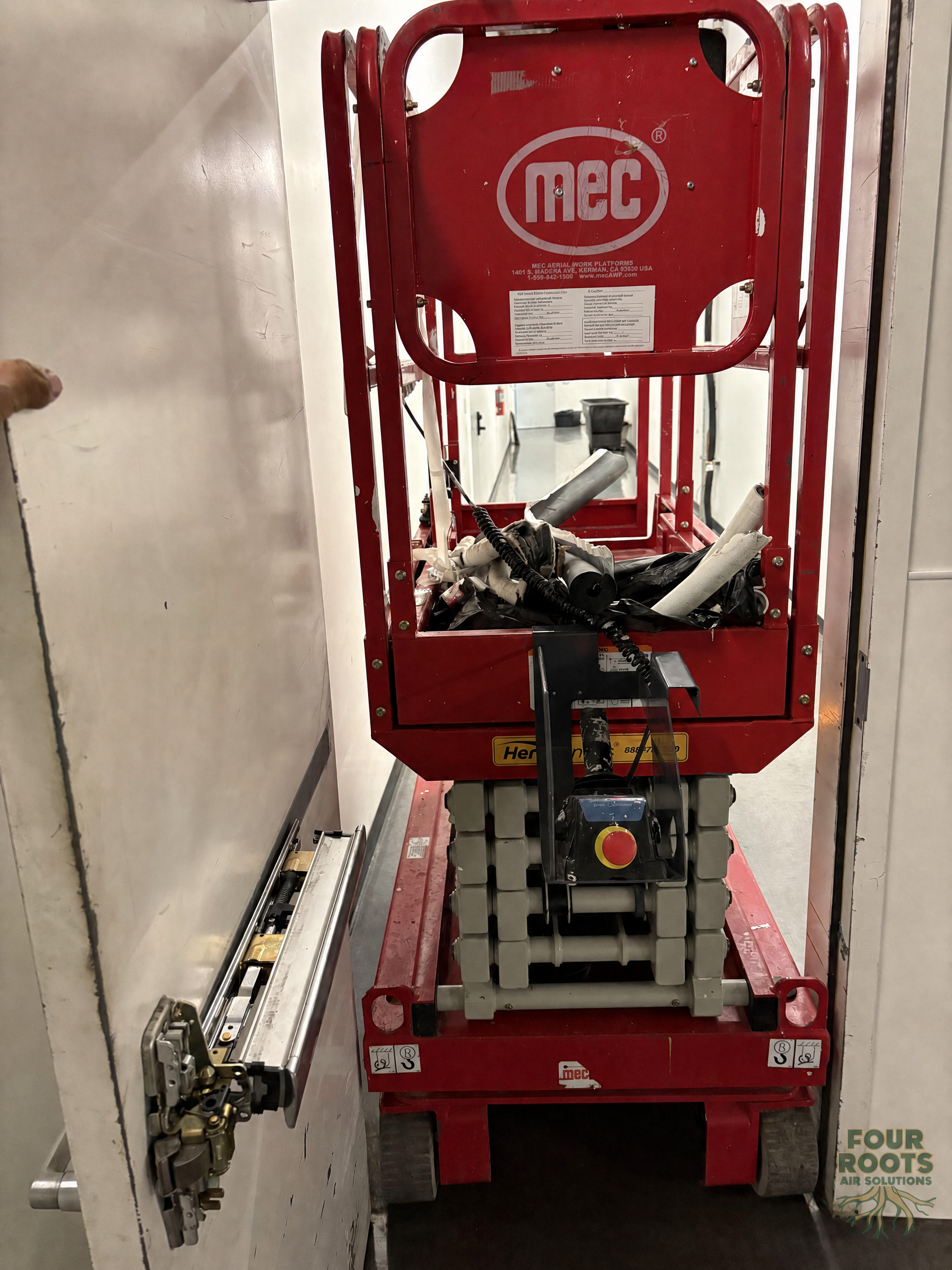
The linesets run above an active commercial kitchen, which meant an aerial lift in a building never designed to accommodate one. It had to be threaded through back-of-house aisles and a service doorway with almost no clearance to spare.
Before anything happened overhead, the sinks and counters underneath got covered. Stainless prep surfaces sit directly below the work area, and anything that comes down from an opened ceiling lands on food contact surfaces. That is the difference between a repair and a health department conversation.

The work itself:
- Strip and dispose of all the wet, soiled, rodent damaged insulation
- Clean and fully dry the refrigerant piping before anything new goes on. New insulation over a wet pipe traps the problem inside.
- Install new closed cell elastomeric foam, 1 inch wall on the freezer lineset and 3/4 inch on the fridge. The freezer line runs colder, so it needs the thicker wall to keep the outer surface above the dew point of the air around it. Matching both lines to the same spec would have left the freezer run marginal.
- Seal every seam, joint, and termination with insulation adhesive. This is the step that makes it a vapor barrier instead of a foam sleeve. An unsealed seam is an open door.
- Verify no remaining exposed copper anywhere on either run
All of it after hours, so the store never lost a service day.
If rodents caused it, rodents will cause it again
Worth being blunt about this. New foam is the same soft material in the same dark cavity. Insulation does not discourage anything on its own.
The restaurant did resolve the rodent activity inside their own suite. The complication is that this is a plaza space, and the ceiling cavity is shared across tenants. A tenant can control what happens above their own leased area and very little past it, so any run crossing into shared ceiling space stays exposed to whatever is happening elsewhere in the building.
That is worth knowing if you lease in a multi-tenant building. Pest control stops at your walls and your refrigerant lines usually do not. Where the cavity is shared, aluminum jacketing over the foam is the layer that does not depend on anyone else’s cooperation, because it is a physical barrier rather than an agreement.
For restaurant and facility operators
- Water above a kitchen near a walk-in is usually not a roof leak. Replacing tiles without finding the source means buying tiles again.
- Ask what condition the lineset insulation is in. It sits out of sight, it is rarely inspected, and it causes expensive collateral damage when it fails.
- Wet insulation cannot be patched. If someone offers to tape it, ask what happens to the saturated foam they are taping over.
Completed, and the dripping stopped
Both linesets were stripped, dried, re-insulated, and sealed after hours. The store never lost a service day.
The condensation stopped with it. No sweating copper, no water on the ceiling grid, and no more tiles to replace.
Four Roots Air Solutions handles commercial refrigeration and HVAC across the Sacramento Valley and Placer County corridor, including after hours work for restaurants that cannot shut down for a repair.
(916) 664-4843 | 4rootsair.com | CSLB #1147036
Leave a Reply